Pokémon
0


Pokémon
Pokémon (ポケモン Pokemon?, /ˈpoʊkeɪˌmɒn/ poh-kay-mon)[1][2] is a media franchise owned by The Pokémon Company,[3] and created by Satoshi Tajiri in 1995.[4] It is centered on fictional creatures called "Pokémon", which humans known as Pokémon Trainers catch and train to battle each other for sport.
The franchise began as a pair of video games for the original Game Boy, developed by Game Freak and published by Nintendo. The franchise now spans video games, trading card games, animated television shows and movies, comic books, and toys. Pokémon is the second-most successful and lucrative video game-based media franchise in the world, behind only Nintendo's Mario franchise.[5]
The franchise celebrated its tenth anniversary in 2006.[6] Cumulative sales of the video games (including home console games, such as Hey You, Pikachu! for the Nintendo 64) have reached more than 200 million copies.[7] In November 2005, 4Kids Entertainment, which had managed the non-game related licensing of Pokémon, announced that it had agreed not to renew the Pokémon representation agreement. Pokémon USA Inc. (now The Pokémon Company International), a subsidiary of Japan's Pokémon Co., now oversees all Pokémon licensing outside of Asia.[8] As of 2013, the Pokémon media franchise has grossed revenues of ¥4 trillion worldwide[9] (equivalent to US$37.76 billion). The brand earned $2 billion in 2014 alone.[10]
2016 marks the 20th anniversary of the release of the original games, with the company celebrating by airing an ad during Super Bowl 50, and issuing re-releases of Pokémon Red, Blue, and Yellow.[11][12] The year will also see the launch of the augmented reality game Pokémon GO.
Name
The name Pokémon is the romanized contraction of the Japanese brand Pocket Monsters (ポケットモンスター Poketto Monsutā?).[13] The term Pokémon, in addition to referring to the Pokémon franchise itself, also collectively refers to the 722 known fictional species that have made appearances in Pokémon media as of the release of the sixth generation titles Pokémon X and Y. "Pokémon" is identical in both the singular and plural, as is each individual species name; it is grammatically correct to say "one Pokémon" and "many Pokémon", as well as "one Pikachu" and "many Pikachu".[14] (However, Pokémon Red, Blue, and Yellow feature NPCs referring to the plurals of Clefairy and Diglett with an "s" at the end, shown "CLEFAIRYs" and "DIGLETTs", respectively. This was fixed in FireRed and LeafGreen.)
Concept
Tajiri first thought of Pokémon around 1989 or 1990, when the Game Boy was first released. The concept of the Pokémon universe, in both the video games and the general fictional world of Pokémon, stems from the hobby of insect collecting, a popular pastime which Pokémon executive director Satoshi Tajiri enjoyed as a child.[15] Players of the games are designated as Pokémon Trainers, and in the main series Pokémon games, these trainers have two general goals. These are to complete the Pokédex by collecting all of the available Pokémon species found in the fictional region where that game takes place; and to train a team of powerful Pokémon from those they have caught to compete against teams owned by other Trainers, and eventually win the fictional Pokémon League. These themes of collecting, training, and battling are present in almost every version of the Pokémon franchise, including the video games, the anime and manga series, and the Pokémon Trading Card Game.
In most incarnations of the fictional Pokémon universe, a Trainer that encounters a wild Pokémon is able to capture that Pokémon by throwing a specially designed, mass-producible spherical tool called a Poké Ball at it. If the Pokémon is unable to escape the confines of the Poké Ball, it is officially considered to be under the ownership of that Trainer. Afterwards, it will obey whatever its new master commands, unless the Trainer demonstrates such a lack of experience that the Pokémon would rather act on its own accord. Trainers can send out any of their Pokémon to wage non-lethal battles against other Pokémon; if the opposing Pokémon is wild, the Trainer can capture that Pokémon with a Poké Ball, increasing his or her collection of creatures. Pokémon already owned by other Trainers cannot be captured, except under special circumstances in certain games. If a Pokémon fully defeats an opponent in battle so that the opponent is knocked out (i.e., "faints"), the winning Pokémon gains experience points and may level up. When leveling up, the Pokémon's statistics ("stats") of battling aptitude increase, such as Attack and Speed. From time to time the Pokémon may also learn new moves, which are techniques used in battle. In addition, many species of Pokémon possess the ability to undergo a form of metamorphosis and transform into a similar but stronger species of Pokémon, a process called evolution.
In the main series, each game's single-player mode requires the Trainer to raise a team of Pokémon to defeat many non-player character (NPC) Trainers and their Pokémon. Each game lays out a somewhat linear path through a specific region of the Pokémon world for the Trainer to journey through, completing events and battling opponents along the way (including foiling the plans of a Team of Pokémon Trainers who serve as antagonists to the player). Each game features eight especially powerful Trainers, referred to as Gym Leaders, that the Trainer must defeat in order to progress. As a reward, the Trainer receives a Gym Badge, and once all eight badges are collected, that Trainer is eligible to challenge the region's Pokémon League, where four immensely talented trainers (referred to collectively as the "Elite Four") challenge the Trainer to four Pokémon battles in succession. If the trainer can overcome this gauntlet, he or she must then challenge the Regional Champion, the master Trainer who had previously defeated the Elite Four. Any Trainer who wins this last battle becomes the new champion.
Video games
Main article: Pokémon (video game series)
Generations
The original Pokémon games were role-playing games (RPGs) with an element of strategy, and were created by Satoshi Tajiri for the Game Boy. These RPGs, and their sequels, remakes, and English language translations, are still considered the "main" Pokémon games, and the games which most fans of the series are referring to when they use the term "Pokémon games". All of the licensed Pokémon properties overseen by The Pokémon Company International are divided roughly by generation. These generations are roughly chronological divisions by release; every several years, when an official sequel in the main RPG series is released that features new Pokémon, characters, and gameplay concepts, that sequel is considered the start of a new generation of the franchise. The main games and their spin-offs, the anime, manga, and trading card game are all updated with the new Pokémon properties each time a new generation begins. The franchise began the sixth generation on October 12, 2013.
A rival battle between a Bulbasaur and a Charmander in Pokémon Red and Blue[16]
The Pokémon franchise started off in its first generation with its initial release of Pocket Monsters Aka and Midori ("Red" and "Green", respectively) for the Game Boy in Japan. When these games proved extremely popular, an enhanced Ao ("Blue") version was released sometime after, and the Ao version was reprogrammed as Pokémon Red and Blue for international release. The games launched in the United States on September 30, 1998. The original Aka and Midori versions were never released outside Japan.[17] Afterwards, a further enhanced version titled Pokémon Yellow: Special Pikachu Edition was released to partially take advantage of the color palette of the Game Boy Color, as well as to feature more elements from the popular Pokémon anime. This first generation of games introduced the original 151 species of Pokémon, in National Pokédex order, encompassing all Pokémon from Bulbasaur to Mew. It also introduced the basic game concepts of capturing, training, battling, and trading Pokémon with both computer and human players. These versions of the games take place within the fictional Kanto region, inspired by the real world Kantō region of Japan, though the name "Kanto" was not used until the second generation.
The second generation of Pokémon began in 1999 with the release of Pokémon Gold and Silver for Game Boy Color. Like the previous generation, an enhanced version titled Pokémon Crystal was later released. The second generation introduced 100 new species of Pokémon, starting with Chikorita and ending with Celebi. It totaled 251 Pokémon to collect, train, and battle, set in Johto, inspired by Japan's Kansai region. The Pokémon mini is a handheld game console released in November 2001 in North America, December 2001 in Japan, and 2002 in Europe.
Pokémon entered its third generation with the 2002 release of Pokémon Ruby and Sapphire for Game Boy Advance and continued with the Game Boy Advance remakes of Pokémon Red and Blue, Pokémon FireRed and LeafGreen, and an enhanced version of Pokémon Ruby and Sapphire titled Pokémon Emerald. The third generation introduced 135 new Pokémon, starting with Treecko and ending with Deoxys, for a total of 386 species. It is set in Hoenn, inspired by Japan's Kyushu region. However, this generation also garnered some criticism for leaving out several gameplay features, including the day-and-night system introduced in the previous generation. It was also the first installment that encouraged the player to collect merely a selected assortment of the total number of Pokémon rather than every existing species. By contrast, 202 out of 386 species are catchable in the Ruby and Sapphire versions.
In 2006, Japan began the fourth generation of the franchise with the release of Pokémon Diamond and Pearl for Nintendo DS. The fourth generation introduced another 107 new species of Pokémon, starting with Turtwig and ending with Arceus, bringing the total of Pokémon species to 493.[18] The Nintendo DS "touch screen" allows new features to the game such as cooking poffins with the stylus and using the "Pokétch". New gameplay concepts include a restructured move-classification system, online multiplayer trading and battling via Nintendo Wi-Fi Connection, the return and expansion of the second generation's day-and-night system, the expansion of the third generation's Pokémon Contests into "Super Contests", and the new region of Sinnoh. This region was inspired by Japan's Hokkaido region and part of Russia's Sakhalin, and has an underground component for multiplayer gameplay in addition to the main overworld. Pokémon Platinum, the enhanced version of Diamond and Pearl—much like Pokémon Yellow, Crystal, and Emerald—was released in September 2008 in Japan, March 2009 in North America, and May 2009 in Australia and Europe. Spin-off titles in the fourth generation include the Pokémon Stadium follow-up Pokémon Battle Revolution for Wii, which has Wi-Fi connectivity as well.[19] Nintendo announced in May 2009 that enhanced remakes of Pokémon Gold and Silver, entitled Pokémon HeartGold and SoulSilver, would be released for the Nintendo DS system. HeartGold and SoulSilver are set in the Johto region and were released in September 2009 in Japan.[20]
The fifth generation of Pokémon began on September 18, 2010, with the release of Pokémon Black and White in Japan for Nintendo DS.[21] The games were originally announced by the Pokémon Company on January 29, 2010, with a tentative release later that year.[22][23] The final release date of September 18 was announced on June 27, 2010.[24] This version is set in the Unova region (イッシュ地方 Isshu-chihō?, Isshu region), inspired by New York City, and utilizes the Nintendo DS's 3-D rendering capabilities to a greater extent than Platinum, HeartGold, and SoulSilver, as shown in game footage of the player walking through the Castelia City (ヒウンシティ Hiun Shiti?) metropolis. A total of 156 new Pokémon were introduced, starting with Victini and ending with Genesect, bringing the franchise's total to 649.[25] It also deployed new game mechanics such as the C Gear (Cギア C Gia?) wireless interactivity features[26] and the ability to upload game data to the Internet and to the player's own computer.[27] Pokémon Black and White was released in Europe on March 4, 2011, in North America on March 6, 2011, and in Australia on March 10, 2011. On June 23, 2012, Nintendo released Pokémon Black 2 and Pokémon White 2 in Japan for Nintendo DS, with early October releases in North America and Europe. Black 2 and White 2 are sequels to Black and White, with several events in the second games referencing events in the first; they also allow players to link their previous Black or White with their Black 2 or White 2, introducing several events based on how they played their previous game.
Officially announced on January 8, 2013, and released simultaneously worldwide on October 12, 2013, Pokémon X and Y for the Nintendo 3DS are part of the sixth generation of games.[28] Introducing the France-inspired Kalos region, these are the first Pokémon games rendered in 3D, and the first released worldwide together.[29] On May 7, 2014, Nintendo announced remakes of the third generation games Pokémon Ruby and Sapphire titled Pokémon Omega Ruby and Alpha Sapphire which were released in Japan, North America, Australia, and South Korea on November 21, 2014, and in Europe on November 28, 2014.
Officially announced on February 26, 2016, Pokémon Sun and Moon for the Nintendo 3DS are part of the seventh generation of games, and the celebrations for the 20th anniversary of the franchise. Both games will be available worldwide during the holiday season in nine different languages; Japanese, English, French, Italian, German, Spanish, Korean and Chinese (Traditional and Simplified).[30]
Game mechanics
Main article: Gameplay of Pokémon
The main staple of the Pokémon video game series revolves around the catching and battling of Pokémon. Starting with a starter Pokémon, the player can catch wild Pokémon by weakening them and catching them with Poké Balls. Conversely, they can choose to defeat them in battle in order to gain experience for their Pokémon, raising their levels and teaching them new moves. Certain Pokémon can evolve into more powerful forms by raising their levels or using certain items. Throughout the game, players will have to battle other trainers in order to progress, with the main goal to defeat various Gym Leaders and earn the right to become a tournament champion. Subsequent games in the series have introduced various side games and side quests, including the Battle Frontiers that display unique battle types and the Pokémon Contests where visual appearance is put on display.
Starter Pokémon
The Pokémon used by trainers in the Hoenn region, from left to right they are Torchic, a Fire type, Treeko, a Grass type, and Mudkip, a Water type which has recently become famous due to a meme
One of the consistent aspects of the Pokémon games—spanning from Pokémon Red and Blue on the Game Boy to the Nintendo 3DS games Pokémon Omega Ruby and Alpha Sapphire—is the choice of one of three different Pokémon at the start of the player's adventures; these three are often labeled "starter Pokémon". Players can choose a Grass-type, a Fire-type, or a Water-type.[31] For example, in Pokémon Red and Blue (and their respective remakes, Pokémon FireRed and Pokémon LeafGreen), the player has the choice of starting with Bulbasaur, Charmander, or Squirtle. The exception to this rule is Pokémon Yellow (a remake of the original games that follows the story of the Pokémon anime), where players are given a Pikachu, an Electric-type mouse Pokémon, famous for being the mascot of the Pokémon media franchise; in this game, however, the three starter Pokémon from Red and Blue can be obtained during the quest by a single player, something that is not possible in any other installment of the franchise.[32] Another consistent aspect is that the player's rival will always choose as his or her starter Pokémon the one that has a type advantage over the player's Pokémon. For instance, if the player picks a Grass-type Pokémon, the rival will always pick the Fire-type starter. An exception to this is again Pokémon Yellow, in which the rival picks an Eevee, but whether this Eevee evolves into Jolteon, Vaporeon, or Flareon is decided by when the player wins and loses to the rival through the journey. The GameCube games Pokémon Colosseum and Pokémon XD: Gale of Darkness also contain an exception; whereas in most games the player's initial Pokémon starts at Level 5, in these two games the player's initial Pokémon starts at Levels 10 and 25, respectively. In Colosseum the player's starter Pokémon are Espeon and Umbreon, while in Gale of Darkness the player's starter is Eevee.
Pokédex
The Pokédex is a fictional electronic device featured in the Pokémon video game and anime series. In the games, whenever a Pokémon is first captured, its data will be added to a player's Pokédex, but in the anime or manga, the Pokédex is a comprehensive electronic reference encyclopedia, usually referred to in order to deliver exposition. "Pokédex" is also used to refer to a list of Pokémon, usually a list of Pokémon by number. In the video games, a Pokémon Trainer is issued a blank device at the start of the journey. A trainer must then attempt to fill the Pokédex by encountering and at least briefly obtaining each of the different species of Pokémon. A player will receive the name and image of a Pokémon after encountering one that was not previously in the Pokédex, typically after battling said Pokémon either in the wild or in a trainer battle (with the exceptions of link battles and tournament battles, such as in the Battle Frontier). In Pokémon Red and Blue, some Pokémon's data is added to the Pokédex simply by viewing the Pokémon, such as in the zoo outside of the Safari Zone. Also, certain NPC characters may add to the Pokédex by explaining what a Pokémon looks like during conversation. More detailed information is available after the player obtains a member of the species, either through capturing the Pokémon in the wild, evolving a previously captured Pokémon, hatching a Pokémon egg (from the second generation onwards), or through a trade with another trainer (either an NPC or another player). This information includes height, weight, species type, and a short description of the Pokémon. Later versions of the Pokédex have more detailed information, like the size of a certain Pokémon compared to the player character, or Pokémon being sorted by their habitat (so far, the latter feature is only in the FireRed and LeafGreen versions). The most current forms of Pokédex are capable of containing information on all Pokémon currently known. The GameCube games, Pokémon Colosseum and Pokémon XD: Gale of Darkness, have a Pokémon Digital Assistant (P★DA) which is similar to the Pokédex, but also tells what types are effective against a Pokémon and gives a description of its abilities.[33]
In other media
Ash Ketchum and Pikachu together in the pilot episode, "Pokémon, I Choose You!"
Anime series
Main article: Pokémon (anime)
The Pokémon anime series and films are a meta-series of adventures separate from the canon that most of the Pokémon video games follow (with the exception of Pokémon Yellow, a game based loosely on the anime storyline). The anime follows the quest of the main character, Ash Ketchum[34] (known as Satoshi in Japan) a Pokémon Master in training, as he and a small group of friends[34] travel around the fictitious world of Pokémon along with their Pokémon partners. The original series, titled Pocket Monsters, or simply Pokémon in Western countries (often referred to as Pokémon: Gotta Catch 'Em All to distinguish it from the later series), begins with Ash's first day as a Pokémon trainer. His first (and signature) Pokémon is a Pikachu, differing from the games, where only Bulbasaur, Charmander, or Squirtle could be chosen.[35] The series follows the storyline of the original games, Pokémon Red and Blue, in the region of Kanto. Accompanying Ash on his journeys are Brock, the Pewter City Gym Leader, and Misty, the youngest of the Gym Leader sisters from Cerulean City. Pokémon: Adventures in the Orange Islands follows Ash's adventures in the Orange Islands, a place unique to the anime, and replaces Brock with Tracey Sketchit, an artist and "Pokémon watcher". The next series, based on the second generation of games, include Pokémon: Johto Journeys, Pokémon: Johto League Champions, and Pokémon: Master Quest, following the original trio of Ash, Brock, and Misty in the western Johto region.
The saga continues in Pokémon: Advanced, based on the third generation games. Ash and company travel to Hoenn, a southern region in the Pokémon World. Ash takes on the role of a teacher and mentor for a novice Pokémon trainer named May. Her brother Max accompanies them, and though he isn't a trainer, he knows large amounts of handy information. Brock (from the original series) soon catches up with Ash, but Misty has returned to Cerulean City to tend to her duties as a gym leader (Misty, along with other recurring characters, appears in the spin-off series Pokémon Chronicles). The Advanced series concludes with the Battle Frontier saga, based on the Emerald version and including aspects of FireRed and LeafGreen. It ended with Max leaving to pick his starter Pokémon and May going to the Grand Festival in Johto.
In the Diamond and Pearl series, based on the fourth generation games, Ash, Brock, and a new companion, an aspiring Pokémon coordinator named Dawn, travel through the region of Sinnoh. At the end of the series, Ash and Brock return to Kanto where Brock begins to follow his newfound dream of becoming a Pokémon doctor himself.
Pocket Monsters: Best Wishes!, based on the fifth generation games, features Ash and Pikachu traveling through the region of Unova (Isshu in Japan) alongside two new companions, Iris and Cilan (Dent in Japan) who part ways with them after returning to Kanto.
Pocket Monsters: XY (ポケットモンスターXY Poketo Monsutā Ekkusu Wai?), is the current airing series based on the sixth generation games, following Ash and Pikachu's journey through the region of Kalos, accompanied by Ash's childhood friend Serena and the siblings Clemont and Bonnie.[36][37][38]
In addition to the TV series, seventeen Pokémon films have been made, with the pair of films, Pokémon the Movie: Black—Victini and Reshiram and White—Victini and Zekrom considered together as one. Collectible bonuses, such as promotional trading cards, have been available with some of the films. Various children's books, collectively known as Pokémon Junior, are also based on the anime.[39]
The Powerpuff Girls
0

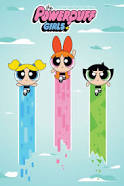
The Powerpuff Girls
The Powerpuff Girls is an American animated television series created by animator Craig McCracken for Cartoon Network. The show centers on Blossom, Bubbles, and Buttercup, three girls with superpowers, as well as their father, the brainy scientist Professor Utonium, who all live in the fictional city of Townsville, USA. The girls are frequently called upon by the town's childlike and naive mayor to help fight nearby criminals using their powers.
McCracken originally developed the show in 1992 as a cartoon short entitled Whoopass Stew! while in his second year at CalArts. Following a name change, Cartoon Network featured the first Powerpuff Girls pilots in its animation showcase program What a Cartoon! in 1995 and 1996. The series made its official debut as a Cartoon Cartoon on November 18, 1998,[2] with the final episode airing on March 25, 2005.[3] A total of 78 episodes were aired in addition to two pilot shorts, a Christmas special, and a feature film. In addition, a tenth anniversary special was made in 2008. A CGI special was also made in 2014 without McCracken's input.
The series has been nominated for six Emmy Awards, nine Annie Awards, and a Kids' Choice Award during its run. Spin-off media include an anime, three CD soundtracks, a home video collection, and a series of video games, as well as various licensed merchandise. The series has received generally positive reception and won four awards. On June 16, 2014, Cartoon Network announced that the series will be rebooted and is scheduled to air sometime in 2016.
Premise
The show revolves around the adventures of three girls with superpowers: Blossom (who is pink), Bubbles (blue), and Buttercup (green). The plot of an episode is usually some humorous variation of standard superhero and tokusatsu shows, with the girls using their powers to defend their town from villains and giant monsters. In addition, the girls have to deal with the normal issues that young children face, such as sibling rivalries, loose teeth, personal hygiene, going to school, bed wetting, or dependence on a security blanket. Episodes often contain (more or less) hidden references to older pop culture (especially noticeable in the episode "Meet the Beat Alls," which is an homage to the Beatles). The cartoon always tries to keep different ideas within each episode with some small tributes and parodies thrown in.[6]
The show is set mainly in the city of Townsville, USA. Townsville is depicted as a major American city, with a cityscape consisting of several major skyscrapers. In his review of The Powerpuff Girls Movie, movie critic Bob Longino of The Atlanta Journal-Constitution said, "the intricate drawings emanate 1950s futuristic pizzazz like a David Hockney scenescape," and that the show is "one of the few American creations that is both gleeful pop culture and exquisite high art."[7]
As depicted in the opening sequence of each episode, the Powerpuff Girls were created by Professor Utonium in an attempt "to create the perfect little girls" using a mixture of "sugar, spice, and everything nice" (shown in respective fields of light blue, light green, and pink). However, he accidentally spilled a mysterious substance called "Chemical X" into the mixture, creating, instead of the "perfect little girl", three girls (each possessing one of the above elements dominating her personality), and granting all three superpowers including flight, super strength, super speed, near invulnerability, x-ray vision, super senses, heat vision, and energy projection. In the original pilot, the accidental substance was a can of "Whoopass", which was replaced by "Chemical X" in the aired version.[8]
The three girls all have oval-shaped heads, abnormally large eyes (inspired by Margaret Keane's art[9]), stubby arms and legs, and lack noses, ears, fingers, necks, and flat feet with toes (McCracken preferred them to look more symbolic of actual girls rather than going for a "realistic" look, meaning fewer body parts were needed[10]). They wear dresses that match the colors of their eyes with black stripes, as well as white tights and black Mary Janes. They do not have secret identities. The closing theme to the cartoon offers a nutshell description of the three Powerpuff Girls' personalities: Blossom, commander and the leader. Bubbles, she is the joy and the laughter. Buttercup, 'cause she's the toughest fighter.
Blossom (voiced by Cathy Cavadini) is the tactician and self-proclaimed leader of the Powerpuff Girls. Her personality ingredient is "everything nice", her signature color is pink, and she has long red hair with a red bow. She was named for having spoken freely and honestly to the Professor shortly after her creation as shown in the Powerpuff Girls Movie. She is often seen as the most level-headed, and composed member of the group and also strong and determined.[11] Her unique power is freezing objects with her breath as seen in the episode "Ice Sore".
Bubbles (voiced by Tara Strong in the series and by Kath Soucie in the What a Cartoon! episodes) is the cute and sensitive one. Her personality ingredient is sugar, her signature color is blue, and she has short blonde hair in two pigtails. Bubbles is seen as kind and very sweet but she is also capable of extreme rage and can fight monsters just as well as her sisters can.[11] Her best friend is a stuffed octopus doll she calls "Octi", and she also loves animals. She exhibits the ability to both understand multiple languages and communicate with various animals (squirrels, cats, monsters), and her unique power is emitting supersonic waves with her voice.
Buttercup (voiced by E. G. Daily) is the toughest of the three. Her personality ingredient is spice, her signature color is green, and she has short black hair in a flip. She is a tomboy who loves to get dirty, fights hard and plays rough; she does not plan and is all action.[11] Buttercup is the only Powerpuff Girl without a unique super power (aside from being able to curl her tongue as shown in the episode "Nuthin' Special").[12] McCracken originally wanted to name the character "Bud" until a friend suggested the name Buttercup.[5]
Dragon Tales
0


Dragon Tales
Dragon Tales is an American-Canadian[2][3][4] animated pre-school children's television series created by Jim Coane and Ron Rodecker and developed by Coane, Wesley Eure, Jeffrey Scott, Cliff Ruby and Elana Lesser. The story focuses on the adventures of two siblings, Emmy and Max, and their dragon friends Ord, Cassie, Zak, Wheezie, and Quetzal. The series began broadcasting on the PBS on their PBS Kids block on September 6, 1999, with its final episode aired on November 25, 2005. Re-runs ceased on August 31, 2010. The program's full library of episodes was made available to subscribers of the streaming service Netflix.[5] Though never released in a full season or series format on DVD, numerous individual releases were made available from all seasons on both DVD and VHS formats, a total of at least 17 DVD releases, each typically featuring at least 5 stories from the show, including "Adventures in Dragon Land," "Playing Fair Makes Playing Fun" and the animated / live-action special "Let's Start a Band."[6]
Kellogg's cereal company and their associated products Rice Krispies, Froot Loops and Frosted Flakes were major sponsors throughout the program's run.[7]
Dragon Tales is based on the characters created in 1978[8] by Laguna Beach, California artist and retired educator Ron Rodecker, who was recovering from a coronary artery bypass graft when he began sketching dragons as a means of symbolizing forces in life that were too big to control.[8][9] In 1997, Jim Coane, then a producer at Columbia TriStar Television, found the artwork and developed it into a television series with several writers. Coane then brought the project to the Children's Television Workshop, where Marjorie Kalins helped him and Columbia TriStar Television obtain a grant from the Department of Education and the Corporation for Public Broadcasting. The grant proposal was written by Wesley Eure. As Columbia TriStar was the TV division of two major Hollywood film studios, which in turn were owned by Sony Pictures Entertainment, this made Dragon Tales the first (and so far, only) PBS Kids program to be co-produced by a major Hollywood studio's TV subsidiary; in 2002, C-T was renamed to Sony Pictures Television, a company that would co-produce the third season of the program. Coane was the executive producer for the first two seasons.
The series focused on the exploits of two siblings, Emmy and Max, in possession of an enchanted dragon scale capable of transporting them to a whimsical fantasy land inhabited by colorful anthropomorphic dragons upon their recitation of a rhyme. Befriended by four friendly talking dragons with distinctive personalities, Ord, Cassie, Zak, and Wheezie, they frequently travel to Dragon Land and assist their friends in fulfilling particular quests, assisting them in their daily problems, and learning important morals through their experiences with the educational whimsy of Dragon Land.
Designed to educate preschoolers mildly in Hispanic culture (because of the Spanish origins of a portion of the central characters), during the program's final seasons a new character named Enrique debuted, providing the series with a third protagonist. Surrounded by a variety of unique characters and faced with numerous differing situations, Emmy and Max commonly embark on adventures with their anthropomorphic friends, conquering fears or achieving goals in spite of any obstacles preventing them from doing so.
As a series broadcast on PBS Kids, the program had an educational focus, combining lessons of a pro-social nature with those of more general educational value. Educational topics covered included identifying shapes, learning words and letters in both English and Spanish, counting and basic math. Social topics were also covered, such as good sportsmanship, the importance of being a good friend, overcoming obstacles such as jealousy or fears and getting along with siblings. Many of the show's interstitial song segments, known as "Dragon Tunes," also covered such topics, such as the "Making It Fun" song which encouraged viewers to not complain about having to do seemingly mundane chores such as washing dishes or helping parents with cooking meals, but instead find ways to make them fun. Another, "Hum," encouraged those who had a fear of the dark or trying new things to hum a gentle tune to comfort them. Stated goals of the program's educational philosophy included the encouragement of pursuing new experiences, finding ways to approach and learn from challenges and that learning can come through trying and not succeeding.[11] Despite two of the show's human leads, Emmy and Enrique, being six years old, the show's described target audience was children closer to the age of four.[12]
Another key theme of the program was the encouragement of honest and candid expressions of emotion. In "Cassie, the Green-Eyed Dragon," Cassie felt jealous of her little brother, Finn, when he gets everyone's attention when she takes him to school for "circle time." Discussing the matter with her best friend, Emmy, and Quetzal, the teacher at the School in the Sky, helps her to understand that jealousy is a natural feeling that everyone experiences sometimes, but that there are ways that she can appreciate her brother, while still feeling appreciated herself.[13] In "Feliz Cumpleaños, Enrique," Enrique feels sad and homesick for his birthplace of Colombia when his birthday celebrations in Dragon Land aren't like the traditions of his old home. He talks with Quetzal, who encourages him to cry, even though he had been told that crying was something a boy at his age wasn't supposed to do. After doing so, he feels better and is able to enjoy his party celebrations.[14]
As with Sesame Street, which was also produced by Children's Television Workshop, the program's creators encouraged "co-viewing," the practice of parents or other caregivers watching the program along with their children and engaging in activities such as discussion, singing and dancing, and pretend play.[10] The program's official website offered a number of activities and lesson plans to aid in these efforts.[15] [16]
Emmy[edit]
Emmy, voiced by Andrea Libman, is six years old. She commonly appears as the leader of the group until she gave her position to Enrique while helping him get used to Dragon Land. She is Max's older sister. Her best friend is Cassie, and she is perhaps known for saying, "Definitely!" whenever a good idea arises. Though Emmy is not ashamed to do "girly" things with her best friend, Cassie, she is also heavily into sports and games and generally is up for any activity regardless of traditional gender roles. Though she experiences occasional jealousy of her brother, the two are otherwise usually together within Dragon Land and share many adventures. Though a brave, smart natural leader, she is also impulsive and doesn't always think before she acts. She is typically seen wearing a blue jumper over a red shirt.[17]
Max[edit]
Max, voiced by Danny McKinnon, is four years old. He is Emmy's younger brother. For the most part, he and Emmy get along fine, but occasionally have arguments. He is prone to anger. His best friend is Ord. Though Max loves his older sister, Emmy, he sometimes struggles with being the younger brother, upset about being too little to do certain things, or frustrated when Emmy acts in certain ways. He is an adventurous sort and sometimes helps to give courage to Ord when he's afraid of things like visiting a dark forest. He is kind to others and encourages Emmy when she is at first reluctant about allowing Enrique to share the secret of Dragon Land. He often enjoys acting silly or goofy. He sometimes acts in a stubborn manner, determined to prove that a child his age can do things on his own, even when he really needs help. He usually wears a green short-sleeved shirt with yellow on the collar & edges of the shirt-sleeves and brown slacks.[17]
Enrique[edit]
Enrique, voiced by Aida Ortega, is six years old. He is Emmy and Max's new friend who moved from Colombia to the USA and also once lived in Puerto Rico. He is raised by his dad and his grandmother ("abuelita") [18] He first appears in the beginning of Season 3 and travels to Dragon Land with the children. His recent experiences in South America provide more opportunities for the characters to demonstrate the meanings of new Spanish words, much like Dora the Explorer, Rosita From Sesame Street, and Handy Manny as he is bilingual.[18]
He rides with Zak and Wheezie, the 2-headed dragon who rarely flew with any human friends prior to Enrique's debut.
His personality is somewhat bashful, missing his homeland of Colombia and sometimes shy to join in on new experiences and saddened by reminders of times from his former home that he no longer has. However, he finds that he enjoys himself when he allows himself to let go, express his feelings and then move forward to have fun. He is raised by his grandparents and described as an intensely smart and logical character. A series of moves throughout his young life has left him jaded and wary of both making new friends and trying new things. He normally wears a bright yellow short-sleeved shirt and blue jeans.[18]
Ord[edit]
Ord, voiced by Ty Olsson, is the blue male dragon who can turn invisible when he's scared. He is best friends with Max, who rides on his back. Ord is extremely fond of food and always carry's some 'just in case'; A running gag in the show features Ord making "Dragon Corn" by throwing purple popcorn kernels in the air and frying them with his fire breath. Ord is afraid of many things, particularly the dark. He wants to learn to control these fears so that he can have fun with his friends.[19]
Cassie[edit]
Cassie, voiced by Chantal Strand, is a shy, demure, and sweet pink female dragon and Emmy's best friend. She possesses a magical tendency to shrink when unhappy, and may occasionally come across as slightly insecure and uncertain, and is prone to worrying. However, Cassie is distinguished by her maternal sweetness as a result of her responsibilities as an older sister and babysitter to a humongous myriad of younger siblings, and has been shown to be gifted with great singing and dancing abilities, as revealed in one episode. Cassie also is characterized by her color combination consisting of pink and yellow, albeit her body is spotted with blue speckles in some areas. Cassie knows just about everything there is to know about Dragon Land and has a deep love of fairy-tales, both stemming from her love of reading. Her dragon badge glows when she feels confident, but she often worries about making a mistake.[20]
Zak and Wheezie[edit]
Zak and Wheezie, voiced by Jason Michas and Kathleen Barr, are Conjoined twin dragons and are siblings; Zak (green) is the male, and Wheezie (purple) is the female. Zak prefers to pursue things in a logical manner. He is neat and clean, but also worries a lot and is pessimistic about many things. His catch phrase is "Take it easy, Wheezieee!", which he often screams when Wheezie takes off running, dragging him with her. Wheezie is very bold, enthusiastic and hyper but can also be quite messy and loud, much to her brother's annoyance, and is perhaps known for saying, "Loooove it!", when she loves something. She is a quick, wild, and free spirited. She loves to run and do cart-wheels and back- flips, which make Zak nauseous and dizzy. They have a shared love of music and performing and they often perform in talent shows and recitals together.[19]
Zak and Wheezie always fly with Enrique, although prior to his debut, Zak and Wheezie rarely flew with any of their human friends. Their dragon badges glow when they work together and get along, though will sometimes glow independently when one of them accomplishes something on their own of significance. Although they fight a lot, they are very close and care about each other a lot.
Quetzal[edit]
Quetzal, portrayed by Eli Gabay, is an elderly dragon who is the teacher at The School in the Sky where young dragons attend. He has an identical twin brother named Fernando who works in his garden. Quetzal typically speaks with a Mexican accent, and is likely named for the Aztec deity Quetzalcoatl. He tries to encourage his young charges to find solutions to their problems on their own, but is a sounding board who offers stability and comfort, as well as sound advice.[19]
Lorca[edit]
Lorca, voiced by Lenore Zann, is Max, Emmy, Zak, Wheezie, Ord, and Cassie's friend. He is on a wheelchair and is incapable of flight. Despite his physical limitations, however, Lorca enjoys participating in adventures and sports activities and encourages his friends to think of new ways to do things.[21]
Sid Sycamore[edit]
Sid Sycamore, voiced by Scott McNeil, is a talking tree who loves telling jokes that relate to the concept of trees; the dragons' tree house is attached to him. When upset, the children will sometimes go to talk to him to be cheered up by his jokes.[22]
Finn[edit]
Finn, voiced by Ellen Kennedy, is Cassie's younger brother. He is light blue, toddler-aged, attached to his blankie, and only just learning to fly. He is prone to tantrums when upset.[23]
Other characters[edit]
Each of the following have appeared more than once:
Kiki, Cassie's younger sister. Kiki is green. She seems slightly younger than Finn and still drinks from a bottle. She is attached to her "squishy," an oddly shaped fruit that she enjoys squeezing.[24] (Ellen Kennedy)
Cyrus, a lizard-like "slinky serpent"; he often tries to steal others' eggs to eat. (Ian James Corlett)
The Giant of Nod, leader of a group called the Nodlings. While much bigger than his fellow Nodlings, he is smaller than any of the main characters, but is enormously strong. (Blu Mankuma)
Mungus, a giant who lives in a castle in the clouds; he knows many folks in Dragon Land since he can travel far and wide in just a few steps. (Garry Chalk)
Polly Nimbus, the operator of the cloud Factory, which controls Dragon Land's weather. Her surname is a pun off of nimbus clouds. (Kathleen Barr)
Wyatt, a talking wishing well that immediately grants any wish for a single coin. Often tells stereotypically bad puns. He is old friends with Quetzal. Whenever coins pile up too high, he knows it is time for them to emptied and taken to the First Dragon Land Bank. Earlier in the series, he was called Willy. (Doug Parker)
Dr. Booboogone, a veteran pink dragon who works as a doctor. She wears a doctor's coat. (Shirley Milliner)
Captain Scallywag, a pirate who captains a flying galleon. (Scott McNeil)
Eunice, a winged unicorn. She can't see very well, so she wears glasses. (Janyse Jaud)
Arlo, a dragon who works at the Dragon Dump; he has a machine at the Dragon Dump which he calls his lil' ol' recycler that sorts out things that can be used again. (Scott McNeil)
Priscilla, the manager at the lost and found, who during her first appearance, was feeling embarrassed because her wings (often called "feathers") were bigger than those of other dragons. She eventually realized that boy dragons like girl dragons with big wings and raises her self-esteem. (Erin Fitzgerald)
Emmy and Max's parents, they are not seen in the series, but their voices are often heard off-screen in most episodes. They call out to Emmy and Max from downstairs at the beginning or end of an episode. Their mom is voiced by Kathleen Barr, and their dad is voiced by Eli Gabay.[25]
Chilly, a living snowman who lives on top of the Stickleback Mountains with his snowdog Nippy. (French Tickner)
Mr. Pop, a gnome like character that steals Wizzie's voice with his sound switcher. (Ian James Corlett)
Places in Dragon Land[edit]
Dragon Beaver Dam – A dam where the dragonbeavers reside.
The School in the Sky – The school where the dragon children are taught by Quetzal.
Dr. BoobooGone's office – Where dragons go when sick or hurt.
Dragoon Lagoon – A large lagoon seen in many episodes. It is home to creatures called silliguanas and hissyfish. It even has a plug at the bottom just like a bathtub.
The Forest of Darkness – A large forest that holds trees with glowing stars, but is very dark. Ord is very afraid of this forest because of its darkness and other things that inhabit this strange Forest.
Turtle Rock – A rock that is shaped like a turtle.
Singing Springs – A gold fountain that plays music. It is seen in the opening and closing of the Dragon Tunes segment.
Rainbow Canyon – A canyon with pigments that make paint. When it rains, the pigments turn to mud.
The Cloud Factory – Where a dragon named Polly Nimbus manufactures rain clouds, snow clouds, etc., and ejects them into the sky as needed.
Snowy Summit – A frigid, snow-covered mountain range, where Chilly the Snowman and his snow puppy Nippy live.
Stickleback Mountains – Another mountain range, with colored sticks that have to be pulled out carefully.
Chile Valley – A valley with lots of tasty, yet spicy chilly peppers, which are red in color and resemble dragonberries.
Crystal Cave – A giant, crystallized cave where crystals are stored and special crystals dance, with the aid of water from Singing Springs, and some Dandelion fuzzies from the Dandelion Forest.
Crystal Fountain – A fountain inside Crystal Cave for cleaning.
Dandelion Forest – A forest made of dandelions that actually roar and growl and are as tall as trees just like real lions. Ord is so allergic to dandelions that when he sneezes in front of the dandelions, he usually does so with an incredible force that the dandelions lose their seeds and turn sad.
Wyatt the Wishing Well – A well where dragons or people can make wishes, which actually come true if they flip a coin into the well. The well is inhabited by a purple walrus named Wyatt (named Willy in his first appearances) who laughs at lame jokes.
Marshmallow Marsh – A swamp full of sticky marshmallow goo, which is almost impossible to clean off and it is near Mushroom Meadow.
Rainbow Falls – A waterfall where there are always rainbows.
Dragon Land Laundry – A place where dragons do laundry.
Dragon Dump – The place where the citizens of Dragon Land send their garbage to be recycled or disposed of. It's run by a dragon named Arlo.
The Knuckerhole, Zak & Wheezie's home. Of course, there are also lots of other knuckerholes all over Dragonland.
Mushroom Meadow – A large field of mushrooms with "bouncy" tops. The dragons and the children often play there.
"Lost Forever" Hole – A small tunnel formed by a river. According to Ord, any thing that flows on the river through the hole is "lost forever". Because it isn't really explored, it is unknown if this is true or not.
Treasure Trove – A cave where dragons keep their treasure it's guarded by a magic door located in knuckerhole.
Release history[edit]
Dragon Tales premiered on PBS Kids on September 6, 1999 with the episode "To Fly with Dragons / The Forest of Darkness." The installment introduced the characters of Max and Emmy to Dragon Land after discovering a magical dragon scale in their new home and to their new dragon friends. In the first half, they discovered Ord's missing tooth, while the adventures continued in the second story with Ord facing his fear of the dark. A total of forty episodes were aired in the first season, with the finale airing on April 28, 2000. The show's second season premiered on June 4, 2001 and had 25 episodes. 20 of these episodes were broadcast from June 4, 2001 to September 20, 2001. The final installment of this set, "Just the Two of Us / Cowboy Max," was broadcast only in non-U.S. markets such as Guam and Canada and did not premiere to U.S. audiences until the program's third season, though "Cowboy Max" was released on DVD prior to this. The special "Let's Start a Band!," featuring the dragon characters blended with live humans in a musical show based on the program's "Dragon Tunes" segments, was released on March 2, 2003. Following this, no new episodes were aired until February 21, 2005, leading many long-time viewers to believe the program had been quietly canceled. The new season introduced the new character Enrique, an immigrant from Colombia, as well as an updated focus on folk songs and teaching of Spanish. The premiere installment, in two parts, showed Enrique being introduced to the sights and sounds of Dragon Lands, learning to fly on Zak & Wheezie, and having his first adventure. The second half appeared as "The Mystery of the Missing Knuckerholes" in some listings, but on the program was simply titled as Part 2 of the episode. Though 29 episodes were broadcast, including "Just the Two of Us / Cowboy Max," with few exceptions only one story from each was original, while the others were a repeat of a story from the second season, easily identifiable by the absence of Enrique.
The program's first musical album, Dragon Tunes, was released on March 20, 2001 and featured the character themes of Cassie and Ord, as well as tunes such as "Betcha Can," the "Wiggle Song" and "Shake Your Dragon Tail."[26] A second album, More Dragon Tunes, was issued on February 15, 2005. This album introduced the character theme of Zak & Wheezie, as well as a number of new tunes introduced in the program's second and third seasons, including "Hola," "Make a New Friend" and remixes of two previous themes, "Shake Your Dragon Tail" and "Dance."[27]
Throughout its history, a number of tie-in book releases were printed, some based on installments of the television program, others not. These included Cassie Loves a Parade,[28] Ord Makes a Wish[29] and Taking Care of Quetzal.[30]
Episodes[edit]
Main article: List of Dragon Tales episodes
Dragon Tales aired a total of 93 episodes, 40 in its first season, 24 in its second season and 29 in its third season. Each episode featured two original stories, aired back-to-back, split by the interstitial song segment "Dragon Tunes," all of which were eventually released on the show's music albums. Almost all episodes from the third season, however, generally contained at least one repeat of a story from the program's second season and some were even repeats of material from that season and earlier material from the third season. In all, there were a total of 155 original stories. The show also had two specials: Let's Start a Band and Big, Big Friend Day. Let's Start a Band was a musical feature in which the characters of the show were seen alongside real human children. Big, Big Friend Day, however, was merely a special featuring episodes of Dragon Tales and Clifford the Big Red Dog, with interstitial segments introducing characters from the new series It's a Big Big World. As such, it did not contain any original Dragon Tales material.[1]
Popeye
0


Popeye
Popeye the Sailor Man is a cartoon fictional character, created by Elzie Crisler Segar,[2] who has appeared in comic strips and theatrical and television animated cartoons. He first appeared in the daily King Features comic strip Thimble Theatre on January 17, 1929; Popeye became the strip's title in later years.
Although Segar's Thimble Theatre strip was in its 10th year when Popeye made his debut, the one-eyed (left) sailor quickly became the main focus of the strip, and Thimble Theatre soon became one of King Features' most popular properties during the 1930s. Thimble Theatre was continued after Segar's death in 1938 by several writers and artists, most notably Segar's assistant Bud Sagendorf. The strip continues to appear in first-run installments in its Sunday edition, written and drawn by Hy Eisman. The daily strips are reprints of old Sagendorf stories.
In 1933 Max Fleischer adapted the Thimble Theatre characters into a series of Popeye the Sailor theatrical cartoon shorts for Paramount Pictures. These cartoons proved to be among the most popular of the 1930s, and Fleischer—and later Paramount's own Famous Studios—continued production through 1957. These cartoon shorts are now owned by Turner Entertainment, a subsidiary of Time Warner, and distributed by sister company Warner Bros. Entertainment.
Over the years, Popeye has also appeared in comic books, television cartoons, arcade and video games, hundreds of advertisements[citation needed] and peripheral products (ranging from spinach to candy cigarettes), and the 1980 live-action film directed by Robert Altman that starred comedian Robin Williams as Popeye.
In 2002, TV Guide ranked Popeye #20 on its "50 Greatest Cartoon Characters of All Time" list.[3]
Fictional character and story[edit]
Differences in Popeye's story and characterization vary depending on the medium. Originally Popeye got his strength from rubbing the head of the Whiffle Hen, changing to spinach by 1932.[4] While Swee'Pea is definitively Popeye's ward in the comic strips, he is often depicted as belonging to Olive Oyl in cartoons. The cartoons also occasionally feature members of Popeye's family who have never appeared in the strip, notably his lookalike nephews Peepeye, Pupeye, Pipeye and Poopeye.
Even though there is no absolute sense of continuity in the stories, certain plot and presentation elements remain mostly constant, including purposeful contradictions in Popeye's capabilities. Though at times he seems bereft of manners or uneducated, Popeye is often depicted as capable of coming up with solutions to problems that (to the police, or, most importantly, the scientific community) seem insurmountable. Popeye has, alternatively, displayed Sherlock Holmes-like investigative prowess (determining for instance that his beloved Olive was abducted by estimating the depth of the villains' footprints in the sand), scientific ingenuity (as his construction, within a few hours, of a "spinach-drive" spacecraft), or oversimplified (yet successful) diplomatic arguments (by presenting to diplomatic conferences his own existence—and superhuman strength—as the only true guarantee of world peace). Popeye's pipe also proves to be highly versatile. Among other things, it has served as a cutting torch, jet engine, propeller, periscope, and, of course, a whistle with which he produces his trademark toot. Popeye also on occasion eats spinach through his pipe, sometimes sucking in the can itself along with the contents. He seldom appears to use it to smoke tobacco.[citation needed]
Popeye's exploits are also enhanced by a few recurring plot elements. One is the love triangle among Popeye, Olive and Bluto, and the latter's endless machinations to claim Olive at Popeye's expense. Another is his near-saintly perseverance in overcoming any obstacle to please Olive, who often renounces Popeye for Bluto's dime-store advances. She is the only character Popeye will permit to give him a thumping. Finally, Popeye usually uncovers villainous plots by accidentally sneaking up on the antagonists as they brag about or lay out their schemes.[citation needed]
Thimble Theatre and Popeye comic strips[edit]
Thimble Theatre was cartoonist E. C. Segar's third published strip when it first appeared in the New York Journal on December 19, 1919. The paper's owner William Randolph Hearst also owned King Features Syndicate, which syndicated the strip. It did not attract a large audience at first, and at the end of its first decade appeared in only half a dozen newspapers.
In its early years, the strip featured characters acting out various stories and scenarios in theatrical style (hence the strip's name). It could be classified as a gag-a-day comic in those days.
Thimble Theatre's first main characters/actors were the thin Olive Oyl and her boyfriend, Harold Hamgravy. After the strip moved away from its initial focus, it settled into a comedy-adventure style featuring Olive, Ham Gravy, and Olive's enterprising brother, Castor Oyl. Olive's parents, Cole and Nana Oyl, also made frequent appearances.
Popeye first appeared in the strip on January 17, 1929 as a minor character. He was initially hired by Castor Oyl and Ham to crew a ship for a voyage to Dice Island, the location of a casino owned by the crooked gambler Fadewell. Castor intended to break the bank at the casino using the unbeatable good luck conferred by stroking the hairs on the head of Bernice the Whiffle Hen. Weeks later, on the trip back, Popeye was shot many times by Jack Snork, a stooge of Fadewell's, but survived by rubbing Bernice's head. After the adventure, Popeye left the strip, but due to reader reaction, he was quickly brought back.
The Popeye character became so popular that he was given a larger role, and the strip was expanded into many more newspapers as a result. Though initial strips presented Olive as being less than impressed with Popeye, she eventually left Ham Gravy to become Popeye's girlfriend and Ham Gravy left the strip as a regular. Over the years, however, she has often displayed a fickle attitude towards the sailor. Castor Oyl continued to come up with get-rich-quick schemes and enlisted Popeye in his misadventures. Eventually he settled down as a detective and later on bought a ranch out West. Castor has seldom appeared in recent years.
In 1933, Popeye received a foundling baby in the mail, whom he adopted and named "Swee'Pea." Other regular characters in the strip were J. Wellington Wimpy, a hamburger-loving moocher who would "gladly pay you Tuesday for a hamburger today" (he was also soft-spoken and cowardly; Vickers Wellington bombers were nicknamed "Wimpys" after the character); George W. Geezil, a local cobbler who spoke in a heavily affected accent and habitually attempted to murder or wish death upon Wimpy; and Eugene the Jeep, a yellow, vaguely dog-like animal from Africa with magical powers. In addition, the strip featured the Sea Hag, a terrible pirate, as well as the last witch on earth (her even more terrible sister excepted); Alice the Goon, a monstrous creature who entered the strip as the Sea Hag's henchwoman and continued as Swee'Pea's babysitter; and Toar, a caveman.
Segar's strip was quite different from the cartoons that followed. The stories were more complex, with many characters that never appeared in the cartoons (King Blozo, for example). Spinach usage was rare and Bluto made only one appearance. Segar would sign some of his early Popeye comic strips with a cigar, due to his last name being a homophone of "cigar" (pronounced SEE-gar).
Thimble Theatre soon became one of King Features' most popular strips during the 1930s and, following an eventual name change to Popeye in the 1970s, remains one of the longest running strips in syndication today. The strip carried on after Segar's death in 1938, at which point he was replaced by a series of artists. In the 1950s, a spinoff strip was established, called Popeye the Sailorman.
Doraemon
0

Doraemon (Japanese: ドラえもん) is a Japanese manga series written and illustrated by the manga writing team Fujiko Fujio. The series has also been adapted into a successful anime series and media franchise. The story revolves around a robotic cat named Doraemon, who travels back in time from the 22nd century to aid a pre-teen boy named Nobita Nobi (野比のび太 Nobi Nobita?).
The Doraemon manga series was first published in December 1969 in six different magazines. A total of 1,345 stories were created in the original series, which are published by Shogakukan under the Tentōmushi (てんとう虫?) manga brand, extending to forty-five volumes. The volumes are collected in the Takaoka Central Library in Toyama, Japan, where Fujiko Fujio was born. Turner Broadcasting System bought the rights to the Doraemon anime series in the mid-1980s for a United States English-language release,[1] but canceled it without explanation before broadcasting any episodes. In July 2013 it was announced that the manga would be released digitally in English via the Amazon Kindle e-book service. It is one of the best-selling manga in the world, having sold over 100 million copies.
Awards for Doraemon include the Japan Cartoonists Association Award for excellence Name[edit]
The name "Doraemon" can be roughly translated to "stray." "Dora" derives from "dora neko" (brazen or stray cat, どら猫), and is a corruption of nora (stray). "Emon" 衛門、右衛門 is an archaic component of male given names like Goemon. "Dora" is not derived (directly) from dora 銅鑼, meaning gong, but rather a pun on that and the fact that Doraemon loves dorayaki. The name "Doraemon" (ドラえもん?) is stylized as an unusual mixture of Katakana (ドラ 'dora') and Hiragana (えもん 'emon').
Plot[edit]
The first appearance of Doraemon, who came via the time machine.
Main article: List of Doraemon characters
Doraemon is sent back in time by a young boy named Sewashi Nobi to improve the circumstances of his great-great-grandfather, Nobita, so that his descendants may enjoy a better future. In the original timeline, Nobita experienced nothing but misery and misfortune manifested in the form of very poor grades and bullying throughout his life. This culminates in the burning down of a future business he sets up which leaves his family line beset with financial problems. In order to alter history and better the Nobi family's fortunes, Sewashi initially wanted to send a super-robot to protect Nobita, but with his meager allowance he could only afford an imperfectly-made factory-rejected toy: an anthropomorphic robot cat called Doraemon.
Doraemon has a pocket from which he produces toys, medicines, and tools from the future, all of which are referred to as 'gadgets' by Doraemon. Some of the gadgets are based on real Japanese household devices with fanciful twists, but most are completely science fiction. Thousands of gadgets have been featured in the series with such as the "bamboo-copter", a small head accessory that allows flight and the "Anywhere Door", a door that opens up to any place the user wishes.
Nobita's closest friend is Shizuka Minamoto, who also serves as his romantic interest. Nobita is usually tormented by the bully Takeshi Goda, nicknamed "Gian", and the cunning and arrogant Suneo Honekawa. A typical story consists of Doraemon using one of his gadgets in order to assist Nobita in various ways, often causing more trouble than he was trying to solve.
Media[edit]
Main article: List of non-Japanese Doraemon versions
Manga[edit]
See also: List of Doraemon chapters and List of Doraemon Plus chapters
In December 1969 the Doraemon manga appeared in six different children's monthly magazines published by Shogakukan. The magazines were aimed at children from nursery school to fourth grade. In 1977 CoroCoro Comic was launched as the flagship magazine of Doraemon.[7]
Since the debut of Doraemon in 1969, the stories have been selectively collected into forty-five books published from 1974 to 1996. Shogakukan published a master works collection consisting of Twenty volumes between July 24, 2009 and September 25, 2012.[8][9]
In addition, Doraemon has appeared in a variety of manga series by Shōgakukan. In 2005 Shōgakukan published a series of five more manga volumes under the title Doraemon+ (Doraemon Plus), which were not found in the forty-five Tentōmushi pipi volumes. On December 1, 2014, a sixth volume of Doraemon Plus was published. This was the first volume for eight years.[10]
Ten volumes of the series were available in a bi-lingual edition by Shogakukan English Comics.[11]
In July 2013, Fujiko Fujio Productions announced that they would be collaborating with ebook publisher Voyager Japan and localization company AltJapan Co., Ltd. to release an English language version of the Doraemon manga in full-color digitally via the Amazon Kindle platform in North America.[12] Shogakukan released the first volume in November 2013.[13] This English version incorporates a variety of changes to character names; Nobita is "Noby", Shizuka is "Sue", Suneo is "Sneech", and Gian is "Big G", while dorayaki is "Yummy Bun/Fudgy Pudgy Pie."[14]
Anime[edit]
Television series[edit]
Main articles: Doraemon (1973 anime), Doraemon (1979 anime) and Doraemon (2005 anime)
After a brief and unpopular animated series in 1973 by Nippon Television, Doraemon remained fairly exclusive in manga form until 1979 when a newly formed animation studio, Shin-Ei Animation (Now owned by TV Asahi) produced an anime series of Doraemon.[15] This series became incredibly popular, and ended with 1,787 episodes on March 25, 2005.
Celebrating the anniversary of the franchise, a new Doraemon series began airing on TV Asahi on April 15, 2005 with new voice actors and staff, and updated character designs. On May 12, 2014, TV Asahi Corporation announced an agreement with The Walt Disney Company to bring the 2005 series to the Disney XD television channel in the United States beginning in the summer of that year.[16] Besides using the name changes that were used in AltJapan's English adaptation of the original manga, other changes and edits have also been made to make the show more relatable to an American audience, such as Japanese text being replaced with English text on certain objects like signs and graded papers, and items such as yen notes being replaced by US dollar bills. Confirmed cast member of the new American adaptation include veteran anime voice actress Mona Marshall of South Park fame in the title role of Doraemon and Johnny Yong Bosch of Power Rangers and Bleach fame as Noby. The English dub is produced by Bang Zoom! Entertainment.[17] The series began broadcast in the United Kingdom on Boomerang from August 17.[18] The Disney adaptation will be broadcast in Japan from February 1, 2016. The broadcast will offer the choice of the English voice track or a newly recorded Japanese track.[19]
Feature films[edit]
Further information: List of Doraemon films
In 1980, Toho released the first of a series of annual feature length animated films based on the lengthy special volumes published annually. Unlike the anime and manga (some based on the stories in select volumes), they are more action-adventure oriented and have more of a shōnen demographic, taking the familiar characters of Doraemon and placing them in a variety of exotic and perilous settings. Nobita and his friends have visited the age of the dinosaurs, the far reaches of the galaxy, the heart of darkest Africa (where they encountered a race of sentient bipedal dogs), the depths of the ocean, and a world of magic. Some of the films are based on legends such as Atlantis, and on literary works including Journey to the West and Arabian Nights. Some films also have serious themes, especially on environmental topics and the use of technology. Overall, the films have a somewhat darker tone in their stories, unlike the manga and anime.
Video games[edit]
For more details on this topic, see List of Doraemon video games.
There are a total of 63 Japanese-only video games ranging from platformer games to RPG games, which began with the Emerson's Arcadia 2001 system. Doraemon can also be seen in Namco's popular Taiko no Tatsujin rhythm game series like Taiko no Tatsujin (11 – 14 only), Metcha! Taiko no Tatsujin DS: Nanatsu no Shima no Daibouken, Taiko no Tatsujin Wii, Taiko no Tatsujin Plus, and Taiko no Tatsujin DS: Dororon! Yokai Daikessen!!. The Chinese version of Microsoft's 3D Movie Maker contained a Doraemon-themed expansion pack.
Musical[edit]
Doraemon the Musical: Nobita and the Animal Planet (舞台版ドラえもん のび太とアニマル惑星(プラネット)」。 Butaiban Doraemon: Nobita to Animaru Puranetto?) was a 2008 musical based on the 1990 anime film of the same name.[20] It debuted at Tokyo Metropolitan Art Space on September 4, 2008 running through September 14.[21] Wasabi Mizuta voiced Doraemon.
Reception[edit]
More than 100 million copies of the manga have been sold.[22]
Doraemon was awarded the first Shogakukan Manga Award for children's manga in 1982. In 1997, it was awarded the first Osamu Tezuka Culture Award.[23] In 2008, the Japanese Ministry of Foreign Affairs appointed Doraemon as the first anime cultural ambassador.[24][25] On 22 April 2002, on the special issue of Asian Hero in Time magazine, Doraemon was selected as one of the 22 Asian Heroes. Being the only anime character selected, Doraemon was described as "The Cuddliest Hero in Asia".[26] In 2005, the Taiwan Society of New York selected Doraemon as a culturally significant work of Japanese otaku pop-culture in its exhibit Little Boy: The Arts of Japan's Exploding Subculture, curated by renowned artist Takashi Murakami.[citation needed]
Jason Thompson praised the "silly situations" and "old fashioned, simple artwork", with Doraemon's expression and comments adding to the "surrounding elementary-school mischief".[11]
On September 3, 2012, Doraemon was granted official residence in the city of Kawasaki, one hundred years before he was born.[27]
With the 2013 film, Doraemon: Nobita no Himitsu Dōgu Museum, Doraemon has surpassed Godzilla in terms of overall ticket sales for a film franchise as Toho's most lucrative movie property. The 33 year series (1980-2013) has sold a combined 100 million tickets vs. the 50 year Godzilla series (1954-2004), which sold a combined 99 million tickets.[28] It also became the largest franchise by numbers of admissions in Japan.[29]
Legacy[edit]
Shuttle bus featuring Doraemon to Fujiko.F.Fujio Museum in Kawasaki
A Fujiko F Fujio museum opened in Kawasaki on September 3, 2011, featuring Doraemon as the star of the museum.[30]
As one of the oldest, continuously running icons, Doraemon is a recognizable character in this contemporary generation. Nobita, the show's protagonist, is a break from other characters typically portrayed as special or extraordinary, and this portrayal has been seen as reasons of its appeal as well as the contrary: especially in the United States.[31]
ESP Guitars have made several Doraemon guitars aimed at children.[32][33]
In late 2011, Shogakukan and Toyota joined forces to create a series of live-action commercials as part of Toyota's ReBorn ad campaign. The commercials depict the characters nearly 20 years older. Hollywood actor Jean Reno plays Doraemon.[34]
Doraemon has become a prevalent part of popular culture in Japan. Newspapers also regularly make references to Doraemon and his pocket as something with the ability to satisfy all wishes. Other characters in the series are also referenced frequently on TV shows if their cast resembles them.
Doraemon appears in appeals for charity. TV Asahi launched the Doraemon Fund charity fund to raise money for natural disasters.[35]
Doraemon, Nobita, and the other characters also appear in various educational manga.[36][37] Doraemon is also mentioned in several anime and manga by other manga artists.[citation needed]in 1973, the first Shogakukan Manga Award for children's manga in 1982,[2] and the first Osamu Tezuka Culture Award in 1997. In March 2008 Japan's Foreign Ministry appointed Doraemon as the nation's first "anime ambassador."[3] Ministry spokesman explained the novel decision as an attempt to help people in other countries understand Japanese anime better and to deepen their interest in Japanese culture."[4] The Foreign Ministry action confirms that Doraemon has come to be considered a Japanese cultural icon. In India, its Hindi, Telugu, Tamil translation has been telecasted, where the anime version is the highest-rated kids' show; it won the best Kids' Show award at the Nickelodeon Kids' Choice Awards India.[5] In 2002 the anime character was acclaimed as an "Asian Hero" in a special feature survey conducted by Time Asia magazine.[6] An edited English dub distributed by TV Asahi aired on Disney XD in the United States that started on July 7, 2014 at 12:30 PM, 11:30 AM (Central). On August 17, 2015, Boomerang UK started to broadcast a separate English dub. The film series is the largest by number of admissions in Japan.

Doraemon
Doraemon (Japanese: ドラえもん) is a Japanese manga series written and illustrated by the manga writing team Fujiko Fujio. The series has also been adapted into a successful anime series and media franchise. The story revolves around a robotic cat named Doraemon, who travels back in time from the 22nd century to aid a pre-teen boy named Nobita Nobi (野比のび太 Nobi Nobita?).
The Doraemon manga series was first published in December 1969 in six different magazines. A total of 1,345 stories were created in the original series, which are published by Shogakukan under the Tentōmushi (てんとう虫?) manga brand, extending to forty-five volumes. The volumes are collected in the Takaoka Central Library in Toyama, Japan, where Fujiko Fujio was born. Turner Broadcasting System bought the rights to the Doraemon anime series in the mid-1980s for a United States English-language release,[1] but canceled it without explanation before broadcasting any episodes. In July 2013 it was announced that the manga would be released digitally in English via the Amazon Kindle e-book service. It is one of the best-selling manga in the world, having sold over 100 million copies.
Awards for Doraemon include the Japan Cartoonists Association Award for excellence Name[edit]
The name "Doraemon" can be roughly translated to "stray." "Dora" derives from "dora neko" (brazen or stray cat, どら猫), and is a corruption of nora (stray). "Emon" 衛門、右衛門 is an archaic component of male given names like Goemon. "Dora" is not derived (directly) from dora 銅鑼, meaning gong, but rather a pun on that and the fact that Doraemon loves dorayaki. The name "Doraemon" (ドラえもん?) is stylized as an unusual mixture of Katakana (ドラ 'dora') and Hiragana (えもん 'emon').
Plot[edit]
The first appearance of Doraemon, who came via the time machine.
Main article: List of Doraemon characters
Doraemon is sent back in time by a young boy named Sewashi Nobi to improve the circumstances of his great-great-grandfather, Nobita, so that his descendants may enjoy a better future. In the original timeline, Nobita experienced nothing but misery and misfortune manifested in the form of very poor grades and bullying throughout his life. This culminates in the burning down of a future business he sets up which leaves his family line beset with financial problems. In order to alter history and better the Nobi family's fortunes, Sewashi initially wanted to send a super-robot to protect Nobita, but with his meager allowance he could only afford an imperfectly-made factory-rejected toy: an anthropomorphic robot cat called Doraemon.
Doraemon has a pocket from which he produces toys, medicines, and tools from the future, all of which are referred to as 'gadgets' by Doraemon. Some of the gadgets are based on real Japanese household devices with fanciful twists, but most are completely science fiction. Thousands of gadgets have been featured in the series with such as the "bamboo-copter", a small head accessory that allows flight and the "Anywhere Door", a door that opens up to any place the user wishes.
Nobita's closest friend is Shizuka Minamoto, who also serves as his romantic interest. Nobita is usually tormented by the bully Takeshi Goda, nicknamed "Gian", and the cunning and arrogant Suneo Honekawa. A typical story consists of Doraemon using one of his gadgets in order to assist Nobita in various ways, often causing more trouble than he was trying to solve.
Media[edit]
Main article: List of non-Japanese Doraemon versions
Manga[edit]
See also: List of Doraemon chapters and List of Doraemon Plus chapters
In December 1969 the Doraemon manga appeared in six different children's monthly magazines published by Shogakukan. The magazines were aimed at children from nursery school to fourth grade. In 1977 CoroCoro Comic was launched as the flagship magazine of Doraemon.[7]
Since the debut of Doraemon in 1969, the stories have been selectively collected into forty-five books published from 1974 to 1996. Shogakukan published a master works collection consisting of Twenty volumes between July 24, 2009 and September 25, 2012.[8][9]
In addition, Doraemon has appeared in a variety of manga series by Shōgakukan. In 2005 Shōgakukan published a series of five more manga volumes under the title Doraemon+ (Doraemon Plus), which were not found in the forty-five Tentōmushi pipi volumes. On December 1, 2014, a sixth volume of Doraemon Plus was published. This was the first volume for eight years.[10]
Ten volumes of the series were available in a bi-lingual edition by Shogakukan English Comics.[11]
In July 2013, Fujiko Fujio Productions announced that they would be collaborating with ebook publisher Voyager Japan and localization company AltJapan Co., Ltd. to release an English language version of the Doraemon manga in full-color digitally via the Amazon Kindle platform in North America.[12] Shogakukan released the first volume in November 2013.[13] This English version incorporates a variety of changes to character names; Nobita is "Noby", Shizuka is "Sue", Suneo is "Sneech", and Gian is "Big G", while dorayaki is "Yummy Bun/Fudgy Pudgy Pie."[14]
Anime[edit]
Television series[edit]
Main articles: Doraemon (1973 anime), Doraemon (1979 anime) and Doraemon (2005 anime)
After a brief and unpopular animated series in 1973 by Nippon Television, Doraemon remained fairly exclusive in manga form until 1979 when a newly formed animation studio, Shin-Ei Animation (Now owned by TV Asahi) produced an anime series of Doraemon.[15] This series became incredibly popular, and ended with 1,787 episodes on March 25, 2005.
Celebrating the anniversary of the franchise, a new Doraemon series began airing on TV Asahi on April 15, 2005 with new voice actors and staff, and updated character designs. On May 12, 2014, TV Asahi Corporation announced an agreement with The Walt Disney Company to bring the 2005 series to the Disney XD television channel in the United States beginning in the summer of that year.[16] Besides using the name changes that were used in AltJapan's English adaptation of the original manga, other changes and edits have also been made to make the show more relatable to an American audience, such as Japanese text being replaced with English text on certain objects like signs and graded papers, and items such as yen notes being replaced by US dollar bills. Confirmed cast member of the new American adaptation include veteran anime voice actress Mona Marshall of South Park fame in the title role of Doraemon and Johnny Yong Bosch of Power Rangers and Bleach fame as Noby. The English dub is produced by Bang Zoom! Entertainment.[17] The series began broadcast in the United Kingdom on Boomerang from August 17.[18] The Disney adaptation will be broadcast in Japan from February 1, 2016. The broadcast will offer the choice of the English voice track or a newly recorded Japanese track.[19]
Feature films[edit]
Further information: List of Doraemon films
In 1980, Toho released the first of a series of annual feature length animated films based on the lengthy special volumes published annually. Unlike the anime and manga (some based on the stories in select volumes), they are more action-adventure oriented and have more of a shōnen demographic, taking the familiar characters of Doraemon and placing them in a variety of exotic and perilous settings. Nobita and his friends have visited the age of the dinosaurs, the far reaches of the galaxy, the heart of darkest Africa (where they encountered a race of sentient bipedal dogs), the depths of the ocean, and a world of magic. Some of the films are based on legends such as Atlantis, and on literary works including Journey to the West and Arabian Nights. Some films also have serious themes, especially on environmental topics and the use of technology. Overall, the films have a somewhat darker tone in their stories, unlike the manga and anime.
Video games[edit]
For more details on this topic, see List of Doraemon video games.
There are a total of 63 Japanese-only video games ranging from platformer games to RPG games, which began with the Emerson's Arcadia 2001 system. Doraemon can also be seen in Namco's popular Taiko no Tatsujin rhythm game series like Taiko no Tatsujin (11 – 14 only), Metcha! Taiko no Tatsujin DS: Nanatsu no Shima no Daibouken, Taiko no Tatsujin Wii, Taiko no Tatsujin Plus, and Taiko no Tatsujin DS: Dororon! Yokai Daikessen!!. The Chinese version of Microsoft's 3D Movie Maker contained a Doraemon-themed expansion pack.
Musical[edit]
Doraemon the Musical: Nobita and the Animal Planet (舞台版ドラえもん のび太とアニマル惑星(プラネット)」。 Butaiban Doraemon: Nobita to Animaru Puranetto?) was a 2008 musical based on the 1990 anime film of the same name.[20] It debuted at Tokyo Metropolitan Art Space on September 4, 2008 running through September 14.[21] Wasabi Mizuta voiced Doraemon.
Reception[edit]
More than 100 million copies of the manga have been sold.[22]
Doraemon was awarded the first Shogakukan Manga Award for children's manga in 1982. In 1997, it was awarded the first Osamu Tezuka Culture Award.[23] In 2008, the Japanese Ministry of Foreign Affairs appointed Doraemon as the first anime cultural ambassador.[24][25] On 22 April 2002, on the special issue of Asian Hero in Time magazine, Doraemon was selected as one of the 22 Asian Heroes. Being the only anime character selected, Doraemon was described as "The Cuddliest Hero in Asia".[26] In 2005, the Taiwan Society of New York selected Doraemon as a culturally significant work of Japanese otaku pop-culture in its exhibit Little Boy: The Arts of Japan's Exploding Subculture, curated by renowned artist Takashi Murakami.[citation needed]
Jason Thompson praised the "silly situations" and "old fashioned, simple artwork", with Doraemon's expression and comments adding to the "surrounding elementary-school mischief".[11]
On September 3, 2012, Doraemon was granted official residence in the city of Kawasaki, one hundred years before he was born.[27]
With the 2013 film, Doraemon: Nobita no Himitsu Dōgu Museum, Doraemon has surpassed Godzilla in terms of overall ticket sales for a film franchise as Toho's most lucrative movie property. The 33 year series (1980-2013) has sold a combined 100 million tickets vs. the 50 year Godzilla series (1954-2004), which sold a combined 99 million tickets.[28] It also became the largest franchise by numbers of admissions in Japan.[29]
Legacy[edit]
Shuttle bus featuring Doraemon to Fujiko.F.Fujio Museum in Kawasaki
A Fujiko F Fujio museum opened in Kawasaki on September 3, 2011, featuring Doraemon as the star of the museum.[30]
As one of the oldest, continuously running icons, Doraemon is a recognizable character in this contemporary generation. Nobita, the show's protagonist, is a break from other characters typically portrayed as special or extraordinary, and this portrayal has been seen as reasons of its appeal as well as the contrary: especially in the United States.[31]
ESP Guitars have made several Doraemon guitars aimed at children.[32][33]
In late 2011, Shogakukan and Toyota joined forces to create a series of live-action commercials as part of Toyota's ReBorn ad campaign. The commercials depict the characters nearly 20 years older. Hollywood actor Jean Reno plays Doraemon.[34]
Doraemon has become a prevalent part of popular culture in Japan. Newspapers also regularly make references to Doraemon and his pocket as something with the ability to satisfy all wishes. Other characters in the series are also referenced frequently on TV shows if their cast resembles them.
Doraemon appears in appeals for charity. TV Asahi launched the Doraemon Fund charity fund to raise money for natural disasters.[35]
Doraemon, Nobita, and the other characters also appear in various educational manga.[36][37] Doraemon is also mentioned in several anime and manga by other manga artists.[citation needed]in 1973, the first Shogakukan Manga Award for children's manga in 1982,[2] and the first Osamu Tezuka Culture Award in 1997. In March 2008 Japan's Foreign Ministry appointed Doraemon as the nation's first "anime ambassador."[3] Ministry spokesman explained the novel decision as an attempt to help people in other countries understand Japanese anime better and to deepen their interest in Japanese culture."[4] The Foreign Ministry action confirms that Doraemon has come to be considered a Japanese cultural icon. In India, its Hindi, Telugu, Tamil translation has been telecasted, where the anime version is the highest-rated kids' show; it won the best Kids' Show award at the Nickelodeon Kids' Choice Awards India.[5] In 2002 the anime character was acclaimed as an "Asian Hero" in a special feature survey conducted by Time Asia magazine.[6] An edited English dub distributed by TV Asahi aired on Disney XD in the United States that started on July 7, 2014 at 12:30 PM, 11:30 AM (Central). On August 17, 2015, Boomerang UK started to broadcast a separate English dub. The film series is the largest by number of admissions in Japan.
Johnny Bravo
0

Johnny Bravo is an American animated television series created by Van Partible for Cartoon Network, and the second of the network's Cartoon Cartoons. The series centers on the titular character Johnny Bravo, a muscular and boorish man who tries to get women to date him, though he is usually unsuccessful. He ends up in bizarre situations and predicaments, often accompanied by celebrity guest characters such as Adam West or Donny Osmond. Pop culture references and sly adult-oriented jokes comprise much of the show's humor.
Partible pitched the series to Hanna-Barbera's animation showcase What a Cartoon!, basing it on his senior thesis project he produced while attending Loyola Marymount University. A pilot short aired on Cartoon Network in 1995, and was followed by two more shorts; the popularity of the shorts led to the network commissioning a half-hour series, which premiered on July 14, 1997. The series was renewed for a second season in 1999, during which Partible left and the show was retooled under the direction of Kirk Tingblad. In 2003, Partible returned to the series for a fourth season, restoring it to its original format and style. It ended on August 27, 2004, with a total of four seasons and 67 episodes.
Johnny Bravo received generally positive reviews and is regarded as an iconic Cartoon Network series. During its run, the series was nominated for 4 Annie Awards, 1 YoungStar Award, and 2 Golden Reel Awards. The series is notable for helping launch the careers of several cartoonists, including Seth MacFarlane and Butch Hartman. Spin-off media include comic books, DVD and VHS releases, collectible toys, and video games.
The series centers on Johnny Bravo (voiced by Jeff Bennett), a muscular, boorish, and dimwitted womanizer with a pompadour hairstyle and an Elvis-like voice. Episodes typically revolve around him trying to get a woman to go on a date with him, though his advances are usually rejected and result in the woman in question causing him harm in a comedic way. Johnny's companions are Bunny "Momma" Bravo (Brenda Vaccaro), his lively, extroverted mother; Little Suzy (Mae Whitman), a talkative and intelligent little girl from the neighborhood who has a crush on Johnny; Carl Chryniszzswics (Tom Kenny), an eccentric and timid nerd who idolizes Johnny despite being bullied by him; and Pops (Larry Drake), the greedy owner of the local diner who provides advice to Johnny.
Recurring characters in the series include Master Hamma (Brian Tochi), a Japanese martial arts instructor who teaches Johnny; Donny Osmond (himself), a cheery and optimistic teen idol who irritates Johnny; and Jungle Boy (Cody Dorkin), a little boy who resides in the jungle with talking animals and possesses incredible strength.
Much of the series' humor is derived from celebrity guest star appearances and references to popular culture. For example; one episode of the first season is based around homages to The Twilight Zone,[1] and in another episode, one of the Village People can be seen in the background.[2] The series has had numerous guest stars, including Adam West, Shaquille O'Neal, and Donny Osmond. In the first season, creator Van Partible intended for the show's middle segment to be a form of "Johnny Bravo Meets...", a parody of The New Scooby-Doo Movies, which would features appearances from popular 1970s icons, but guest stars were used informally after the second season began.[3][4] Many Hanna-Barbera characters had cameo appearances in the series, including the cast of Scooby-Doo, Speed Buggy, Jabberjaw, Fred Flintstone, Yogi Bear, The Blue Falcon, Black Widow, and Huckleberry Hound.
Adult humor is found in many episodes of the show. In one episode, when Suzy calls Johnny to ask if he wants to come over, Johnny nonchalantly tells her to "[call] back in 15 years when [she is] a co-ed." In regard to the adult humor, Butch Hartman stated "...being concerned with the content of the episodes wasn't our main focus", and creator Van Partible remembers that "No one was really watching Cartoon Network [...] As far as content, they were pretty lenient on all the kind of things that were going on."[3]
Production[edit]
Development[edit]
While attending Loyola Marymount University, Van Partible produced his senior thesis project Mess O' Blues (1993), an animated short film about an Elvis Presley impersonator.[3] Partible's animation professor showed the film to a friend who worked for Hanna-Barbera, and the studio loved the film. They asked Partible to develop it into a pitch for a seven-minute short, prompting him to sell the project to Hanna-Barbera.[4]
For the new short, Partible revised his main character from Mess O' Blues, renaming him "Johnny Bravo" and making him "this '50s iconic James Dean-looking character that talked like Elvis." Voice actor Jeff Bennett was cast as Johnny, based solely on his young, hyped Elvis impression.[3] Partible, with a small team of animators, animated the short themselves in-house at Hanna-Barbera using digital ink and paint.[2]
The short, titled Johnny Bravo, was aired on Cartoon Network's animation showcase, World Premiere Toons,[3] on March 26, 1995. Two more shorts followed: Jungle Boy in "Mr. Monkeyman" and Johnny Bravo and the Amazon Women.
According to creator Van Partible, the main character was named Johnny Bravo because the name originated from The Brady Bunch episode Adios, Johnny Bravo (1973), where Greg Brady was nicknamed "the next Johnny Bravo". The name was also derived from Partible's middle name, Giovanni Bravo, which Giovanni is also an Italian name for Johnny.[5]
Original seasons[edit]
The popularity of the shorts led to Cartoon Network commissioning a first season of Johnny Bravo, consisting of 13 episodes. The crew of the first season consisted of several writers, animators, and directors from World Premiere Toons, including Seth MacFarlane, Butch Hartman, Steve Marmel, and John McIntyre. Veteran animator Joseph Barbera also served as a creative consultant and mentor for the first season.[6][7] Partible stated in a 1997 interview that the goal of the series was to have "animation reminiscent of the old Hanna-Barbera cartoons".[7]
Johnny Bravo premiered on July 14, 1997,[8] and the first season completed production in December of that year.
Retool[edit]
After the first season, Johnny Bravo was put on hiatus, until it was picked up for an unexpected second season in 1999. Van Partible left production and Kirk Tingblad took over as director, leading to a major retooling in the show's visual style, tone, humor, and characters. The show retained this format for the third season.
The series sat in limbo once again until it was renewed for a fourth season in 2003, which aired in 2004. The final season of the series returned to the humor of the original shorts and first season of the series (although the Jungle Boy characters from the first season never returned).

Johnny Bravo
Johnny Bravo is an American animated television series created by Van Partible for Cartoon Network, and the second of the network's Cartoon Cartoons. The series centers on the titular character Johnny Bravo, a muscular and boorish man who tries to get women to date him, though he is usually unsuccessful. He ends up in bizarre situations and predicaments, often accompanied by celebrity guest characters such as Adam West or Donny Osmond. Pop culture references and sly adult-oriented jokes comprise much of the show's humor.
Partible pitched the series to Hanna-Barbera's animation showcase What a Cartoon!, basing it on his senior thesis project he produced while attending Loyola Marymount University. A pilot short aired on Cartoon Network in 1995, and was followed by two more shorts; the popularity of the shorts led to the network commissioning a half-hour series, which premiered on July 14, 1997. The series was renewed for a second season in 1999, during which Partible left and the show was retooled under the direction of Kirk Tingblad. In 2003, Partible returned to the series for a fourth season, restoring it to its original format and style. It ended on August 27, 2004, with a total of four seasons and 67 episodes.
Johnny Bravo received generally positive reviews and is regarded as an iconic Cartoon Network series. During its run, the series was nominated for 4 Annie Awards, 1 YoungStar Award, and 2 Golden Reel Awards. The series is notable for helping launch the careers of several cartoonists, including Seth MacFarlane and Butch Hartman. Spin-off media include comic books, DVD and VHS releases, collectible toys, and video games.
The series centers on Johnny Bravo (voiced by Jeff Bennett), a muscular, boorish, and dimwitted womanizer with a pompadour hairstyle and an Elvis-like voice. Episodes typically revolve around him trying to get a woman to go on a date with him, though his advances are usually rejected and result in the woman in question causing him harm in a comedic way. Johnny's companions are Bunny "Momma" Bravo (Brenda Vaccaro), his lively, extroverted mother; Little Suzy (Mae Whitman), a talkative and intelligent little girl from the neighborhood who has a crush on Johnny; Carl Chryniszzswics (Tom Kenny), an eccentric and timid nerd who idolizes Johnny despite being bullied by him; and Pops (Larry Drake), the greedy owner of the local diner who provides advice to Johnny.
Recurring characters in the series include Master Hamma (Brian Tochi), a Japanese martial arts instructor who teaches Johnny; Donny Osmond (himself), a cheery and optimistic teen idol who irritates Johnny; and Jungle Boy (Cody Dorkin), a little boy who resides in the jungle with talking animals and possesses incredible strength.
Much of the series' humor is derived from celebrity guest star appearances and references to popular culture. For example; one episode of the first season is based around homages to The Twilight Zone,[1] and in another episode, one of the Village People can be seen in the background.[2] The series has had numerous guest stars, including Adam West, Shaquille O'Neal, and Donny Osmond. In the first season, creator Van Partible intended for the show's middle segment to be a form of "Johnny Bravo Meets...", a parody of The New Scooby-Doo Movies, which would features appearances from popular 1970s icons, but guest stars were used informally after the second season began.[3][4] Many Hanna-Barbera characters had cameo appearances in the series, including the cast of Scooby-Doo, Speed Buggy, Jabberjaw, Fred Flintstone, Yogi Bear, The Blue Falcon, Black Widow, and Huckleberry Hound.
Adult humor is found in many episodes of the show. In one episode, when Suzy calls Johnny to ask if he wants to come over, Johnny nonchalantly tells her to "[call] back in 15 years when [she is] a co-ed." In regard to the adult humor, Butch Hartman stated "...being concerned with the content of the episodes wasn't our main focus", and creator Van Partible remembers that "No one was really watching Cartoon Network [...] As far as content, they were pretty lenient on all the kind of things that were going on."[3]
Production[edit]
Development[edit]
While attending Loyola Marymount University, Van Partible produced his senior thesis project Mess O' Blues (1993), an animated short film about an Elvis Presley impersonator.[3] Partible's animation professor showed the film to a friend who worked for Hanna-Barbera, and the studio loved the film. They asked Partible to develop it into a pitch for a seven-minute short, prompting him to sell the project to Hanna-Barbera.[4]
For the new short, Partible revised his main character from Mess O' Blues, renaming him "Johnny Bravo" and making him "this '50s iconic James Dean-looking character that talked like Elvis." Voice actor Jeff Bennett was cast as Johnny, based solely on his young, hyped Elvis impression.[3] Partible, with a small team of animators, animated the short themselves in-house at Hanna-Barbera using digital ink and paint.[2]
The short, titled Johnny Bravo, was aired on Cartoon Network's animation showcase, World Premiere Toons,[3] on March 26, 1995. Two more shorts followed: Jungle Boy in "Mr. Monkeyman" and Johnny Bravo and the Amazon Women.
According to creator Van Partible, the main character was named Johnny Bravo because the name originated from The Brady Bunch episode Adios, Johnny Bravo (1973), where Greg Brady was nicknamed "the next Johnny Bravo". The name was also derived from Partible's middle name, Giovanni Bravo, which Giovanni is also an Italian name for Johnny.[5]
Original seasons[edit]
The popularity of the shorts led to Cartoon Network commissioning a first season of Johnny Bravo, consisting of 13 episodes. The crew of the first season consisted of several writers, animators, and directors from World Premiere Toons, including Seth MacFarlane, Butch Hartman, Steve Marmel, and John McIntyre. Veteran animator Joseph Barbera also served as a creative consultant and mentor for the first season.[6][7] Partible stated in a 1997 interview that the goal of the series was to have "animation reminiscent of the old Hanna-Barbera cartoons".[7]
Johnny Bravo premiered on July 14, 1997,[8] and the first season completed production in December of that year.
Retool[edit]
After the first season, Johnny Bravo was put on hiatus, until it was picked up for an unexpected second season in 1999. Van Partible left production and Kirk Tingblad took over as director, leading to a major retooling in the show's visual style, tone, humor, and characters. The show retained this format for the third season.
The series sat in limbo once again until it was renewed for a fourth season in 2003, which aired in 2004. The final season of the series returned to the humor of the original shorts and first season of the series (although the Jungle Boy characters from the first season never returned).
The Flintstones
0


The Flintstones
I Yabba-Dabba Do! is a 1993 made-for-television animated film based on the original series, The Flintstones and its spinoff, The Pebbles and Bamm-Bamm Show. It premiered on ABC (the same network the original series was aired) on February 7, 1993. The telefilm had a relatively high level of animation quality.[1]
The film got negative reviews with the Los Angeles times film critic ending her article with the words: "YABBA DABBA DON'T".Pebbles Flintstone, who now works for an ad agency and Bamm Bamm Rubble, who works in a car repair shop, decide to get married after Bamm Bamm proposes with a poem, in the middle of the street (ironically after Pebbles mistakenly thinks he was trying to dump her when Bamm Bamm read her a letter that started "Dear Pebbles"). However, Fred has lost money when he bet his nest egg on his team, the Bedrock Brontos. Fred tries to ask for a raise from Mr. Slate, but his short temper costs him his job.
Fred enlists Barney's help in bringing more money for the wedding, but they fail, losing Barney's money to a real estate con artist. Meanwhile, Wilma's mother Pearl Slaghoople arrives to help with the wedding. Pebbles and Bamm Bamm decide to get married in Rock Vegas because of their parents' arguing and fighting, but after they leave, Wilma and Betty discover the truth about Fred and Wilma's nest egg. Fred is evicted from the house after being physically abused by Wilma, her mother, and Dino and apologizes to Barney, Wilma and Betty before he enlists Barney's help searching for Pebbles and Bamm Bamm.
Fred and Barney go to Rock Vegas looking for Pebbles and Bamm Bamm. They stop at a casino where Barney wins more money. They are attacked by the Wedding Whackers gang after mistaking them for Pebbles and Bamm Bamm getting married and took a photo of them robbing a newlywed couple. Shortly afterwards they are rescued by Pebbles and Bamm Bamm. During the chase, the photo of the Wedding Whackers breaks, so the four are arrested as suspects of being the marriage whackers, along with the real marriage whackers.
While in jail, Fred tells all the trouble he's gone through to try and give Pebbles a nice wedding which leads the marriage whackers to confess to their crimes, to the chagrin of the Whackers' mother. Fred, Barney, Pebbles and Bamm Bamm finally return to Wilma, Betty and the others. Mr. Slate rehires Fred, Pearl and Wilma apologize to Fred for the mistake they made and the abuse they gave him and Pebbles and Bamm Bamm get married. At the end Pebbles and Bamm Bamm reveal they are moving to Hollyrock with Barney paying their way with his Rock Vegas winnings, at which Fred gets angry with Barney and they start to argue as the film ends.
Voice Cast[edit]
Henry Corden as Fred Flintstone
Frank Welker as Barney Rubble and Dino
Jean Vander Pyl as Wilma Flintstone and Martha Slate
B.J. Ward as Betty Rubble
Janet Waldo as Pearl Slaghoople & Additional Voices
Megan Mullally as Pebbles Flintstone-Rubble
Jerry Houser as Bamm-Bamm Rubble
John Stephenson as Mr. George Slate
Joseph Barbera as Himself
William Hanna as Himself
Additional voices[edit]
June Foray
Ronnie Schell
Charlie Brill
Greg Burson
Michael Bell
Ruth Buzzi
Randy Crenshaw
Joan Gerber
Pat Harrington, Jr.
Nick Jameson
Kip King
Brian Stokes Mitchell
Don Messick
Henry Polic II
Howard Morris
Don Reed
Darryll Phinnessee
Alan Oppenheimer
Roger Rose
Home Media Releases[edit]
Warner Home Video released the movie on VHS on April 21, 1998 but it is now out of print.[2]
On October 9, 2012, Warner Archive released The Flintstones- I Yabba-Dabba Do! on DVD in region 1 as part of their Hanna–Barbera Classics Collection. This is a Manufacture-on-Demand (MOD) release, available through Warner's online store, Amazon.com and Wal-Mart.com. http://www.walmart.com/ip/24225538 [3]


